Immunoassays are among the most versatile tools in modern diagnostics. They use the specificity of antibody-antigen reactions to detect and quantify analytes such as proteins, hormones, antibodies, and antigens, making them essential for medical diagnostics, research, therapeutic monitoring, food safety, and environmental applications. For laboratories in the UAE, choosing the right immunoassay system often comes down to a practical question: should the lab invest in ELISA, CLIA, multiplex testing, or a combination of all three?
The answer depends on the laboratory’s workload, clinical focus, reporting needs, and future growth plans. Some labs need broad menu flexibility and open testing options. Others prioritize speed, automation, and high sensitivity. Increasingly, specialized laboratories also want multiplex technologies that can measure multiple markers from a single sample and reduce the inefficiency of sequential testing. This is where InstaMed’s portfolio becomes commercially strong: your immunoassay offering is not limited to one format, but spans ELISA, Snibe CLIA, and TestLine’s MBA multiplex technology.
What immunoassay systems actually do
An immunoassay analyzer is used to identify and detect the concentration of specific substances in a sample, typically using antibodies as reagents. Different immunoassay technologies achieve this in different ways. ELISA uses enzyme-linked detection, CLIA relies on chemiluminescent signal generation, and multiplex assays enable simultaneous detection of several analytes in a single test format. Each has strengths, and each fits different laboratory scenarios.
From an SEO perspective, this distinction is valuable because many users do not search for “immunoassay system” alone. They search for ELISA analyzer UAE, CLIA analyzer UAE, chemiluminescent immunoassay analyzer, multiplex immunoassay, or even disease-focused phrases related to autoimmune, endocrine, infectious disease, or allergy testing. A strong blog should therefore educate users while guiding them toward the format that best fits their lab.
ELISA systems: flexible, established, and broad in assay scope
ELISA remains one of the best-known immunoassay methods in laboratory medicine. InstaMed’s own educational content describes ELISA as a cornerstone of immunoassays used to detect peptides, proteins, antibodies, and hormones. The method is well established, adaptable, and suitable for high-throughput screening, even though it may involve multiple washing and incubation steps compared with more automated chemiluminescent workflows.
For your commercial positioning, ELISA is particularly valuable because InstaMed already offers more than 700 ELISA assays and supports fully automated and semi-automated ELISA analyzers. Your ELISA page also highlights the DRG:HYBRiD-XL, a fully automated random-access device that can process immunoassay and clinical chemistry parameters simultaneously on different biological matrices, including serum, plasma, saliva, urine, whole blood, or stool depending on the parameter. That combination of assay breadth and workflow flexibility is a strong selling point for laboratories that want menu diversity and panel customization.
ELISA is often a good fit when a laboratory values open-platform flexibility, broad assay availability, and practical adaptability across specialized testing needs. It can be especially attractive for labs that want to build tailored diagnostic panels or expand into niche markers without committing all testing to a closed high-throughput chemiluminescent system.
CLIA systems: automation, speed, and high sensitivity
Chemiluminescent immunoassay, or CLIA, is often selected when laboratories need faster throughput, broader automation, and strong analytical performance in a compact footprint. InstaMed’s immunoassay overview describes CLIA as a method that uses chemiluminescent compounds to emit light upon reaction and highlights its high sensitivity and dynamic range.
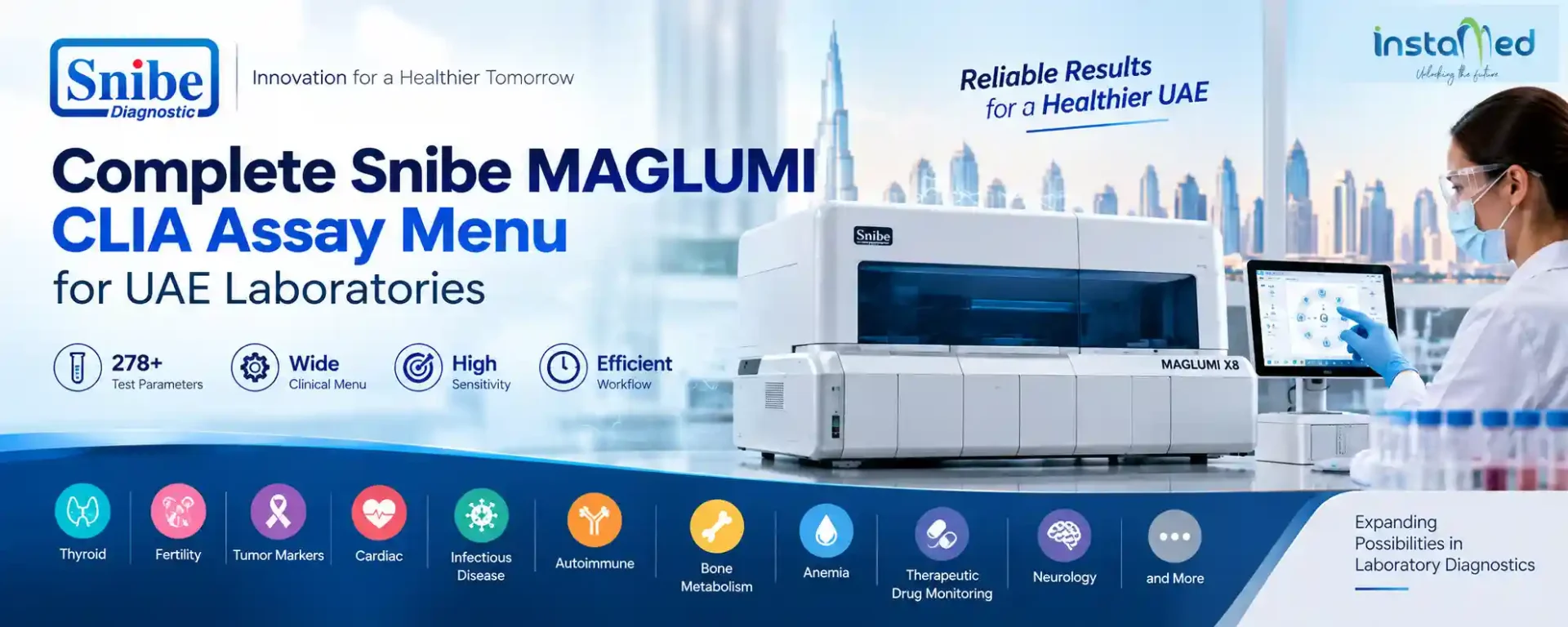
That general benefit becomes much more concrete on your Snibe page. InstaMed presents the Snibe MAGLUMI X3 as a compact CLIA analyzer suited to UAE laboratories with limited space but high turnaround demands, featuring 200 tests per hour, an extensive assay menu, ABEI labeling, magnetic microbead separation, accurate pipetting with liquid-level, clot, and crash detection, as well as no-pause loading of samples and reagents. The page also highlights smart incubation and washing features plus regulatory credibility through FDA 510(k) clearance noted on the page. Snibe’s official product page supports the analyzer’s compact positioning and describes accurate five-sided heating for incubation control.
For laboratories that need reliable daily performance across hormone testing, infectious disease markers, endocrine work, or other routine immunoassay demand, CLIA can deliver a very strong balance of throughput, automation, and standardized workflow. It is especially compelling when space is limited but sample flow remains high, which is a common scenario in many hospital and private lab environments.
Multiplex immunoassay: the case for testing more markers in one run
Multiplex immunoassay becomes highly relevant when a lab needs broader marker coverage from one patient sample, particularly in autoimmune and specialized diagnostic workflows. InstaMed’s own immunoassay education explains multiplex immunoassay as an approach that allows simultaneous detection of multiple analytes in a single sample and describes it as useful for complex diagnostic panels such as allergen testing and autoimmune profiling.
That value is even clearer with TestLine’s Microblot-Array technology. According to TestLine, MBA is a new-generation immunoblot array in microtiter plate format designed for efficient multiplex diagnostics. It enables simultaneous detection of multiple markers, can save time and lower costs, is compatible with existing open ELISA analyzers, and supports LIS connectivity. The manufacturer also highlights key benefits such as multiplex testing with up to 44 antigens in a single well, quantitative results through integrated calibrators, breakable wells for flexible testing, and high-throughput processing combined with individual testing possibilities.
This is a powerful message for specialty labs because multiplex technology is not merely about adding more markers. It can reduce repeat testing, conserve sample volume, improve panel efficiency, and support more comprehensive autoimmune and infectious serology workflows. InstaMed’s own MBA-related page reinforces this by describing highly accurate simultaneous detection of multiple autoimmune markers in a single test, with faster and more reliable results for the laboratory.
ELISA vs CLIA vs multiplex: which system should a lab choose?
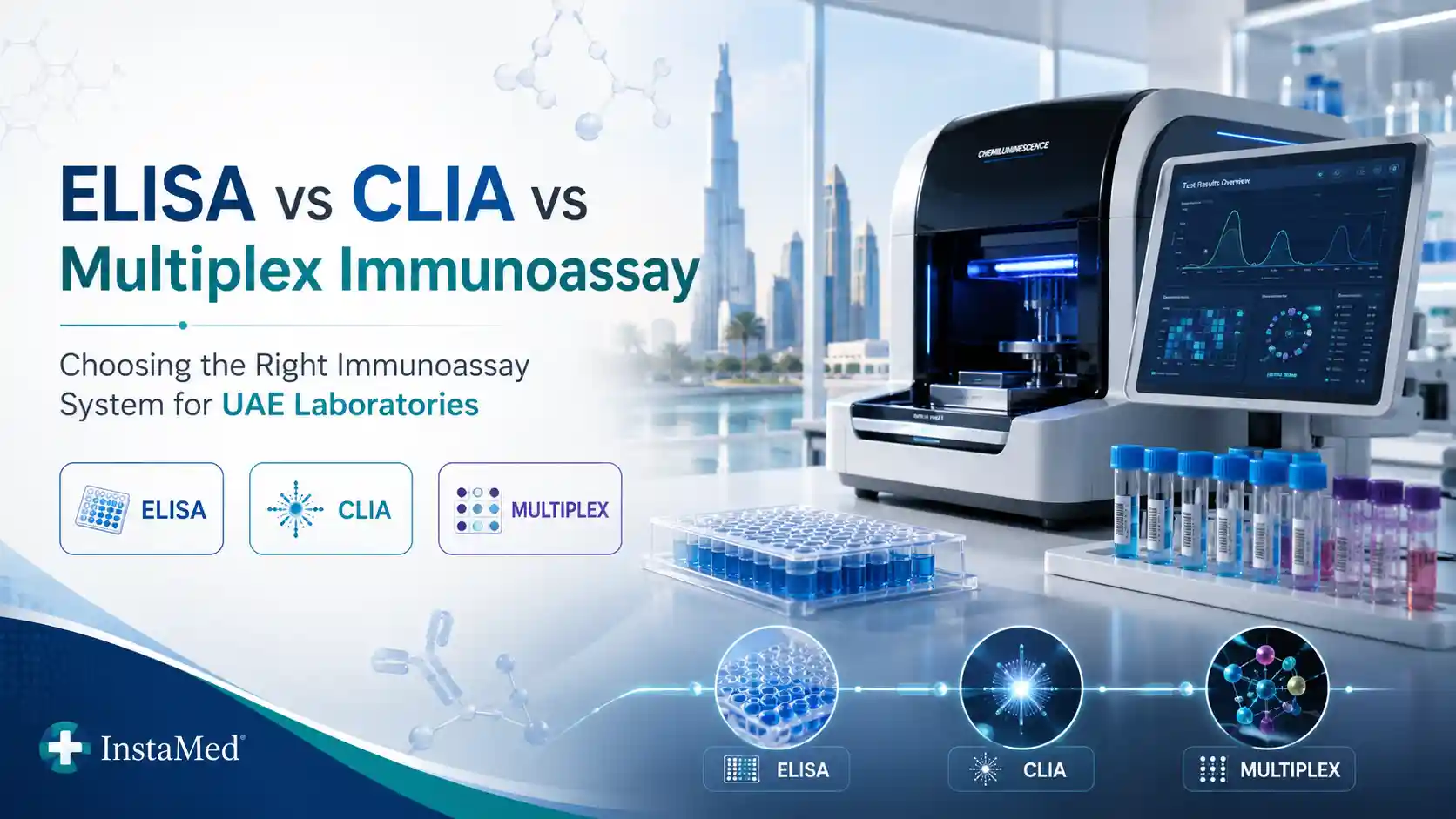
If a laboratory values broad assay selection, open-format flexibility, and specialized panel design, ELISA remains a strong option. If the priority is higher automation, faster daily workflow, and compact chemiluminescent performance, CLIA can be the better fit. If the goal is simultaneous multi-marker analysis, especially in autoimmune or advanced profile testing, multiplex technology offers a compelling advantage. In reality, many modern laboratories benefit from using more than one format because different departments and test menus do not always need the same platform logic.
That is exactly where InstaMed’s portfolio becomes strategically stronger than a single-product pitch. You are able to serve the lab that needs an automated ELISA path, the lab that wants Snibe CLIA automation, and the lab that is ready for multiplex autoimmune diagnostics through TestLine MBA. That breadth creates a better user journey for your website too, because visitors do not have to leave your ecosystem to compare different immunoassay approaches.
FAQ section
What is the difference between ELISA and CLIA?
ELISA uses enzyme-linked detection and is known for versatility and broad assay availability, while CLIA uses chemiluminescent signal generation and is often chosen for high sensitivity, automation, and faster throughput.
What is multiplex immunoassay?
Multiplex immunoassay allows the simultaneous detection of multiple analytes or markers in a single sample, making it useful for complex profiles such as autoimmune and infectious disease panels.
Can multiplex testing work with existing ELISA lab equipment?
TestLine states that MBA processing is compatible with open ELISA analyzers and standard ELISA-type workflows, while reading and evaluation are handled through the MBA reader and software.
Which immunoassay system is best for a UAE laboratory?
That depends on sample volume, assay menu needs, specialization, desired automation level, and whether the lab needs single-analyte or multi-marker testing. Many labs benefit from combining more than one immunoassay approach.